Lifecycle modes
Three ways to run the pair lifecycle, Assisted, Supervised and Autonomous, which assistants support each, and when to use which.
The phases and the two workflows (analysis and refinement, delivery) are the same in every mode. What changes is who drives:
- Assisted: pair guides you through every phase of the process with AI, one skill at a time.
- Supervised: pair automates the work on a single card, from start to finish.
- Autonomous: pair watches the backlog and applies the whole process, on its own, to every card that matches a criterion you set (for example all
risk:greencards, or all UI cards).
Pick per project, or per card.
Think of driving automation
The three modes follow the levels of driving automation in cars.
- Assisted is driver assistance (level 2): you drive, the car helps with lane keeping and distance. In pair you run each skill, the AI does the work inside it.
- Supervised is conditional automation (level 3): the car drives a stretch of road on its own and asks you to take the wheel when it meets something it cannot handle. In pair a workflow takes one card all the way and stops at a checkpoint or an escalation.
- Autonomous is high automation (level 4): the car drives by itself, but only inside a defined area, and pulls over when it leaves it. In pair the loop delivers every card inside the area you define (your selection criterion, risk tier and autonomy gates) and hands a card back to you when classification says a human is needed.
As with cars, you raise the level as trust grows: start Assisted, move to Supervised, and let the low-risk cards run Autonomous.
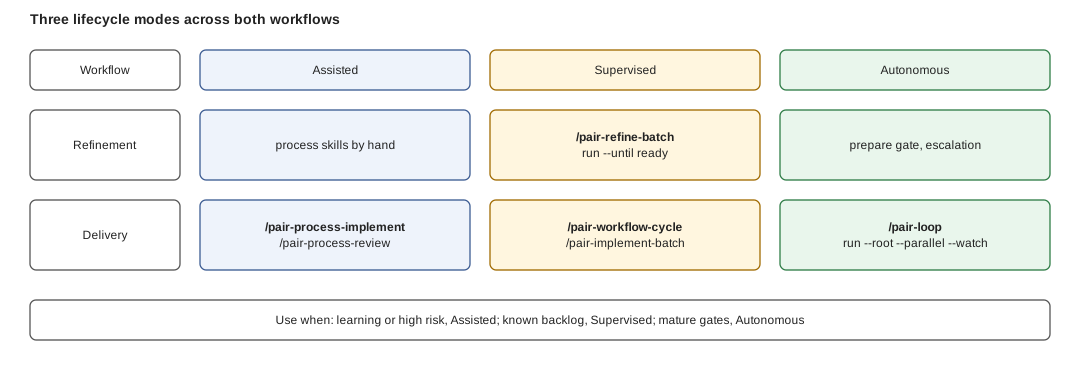
Figure: move right along a row and the human disappears from the loop; move down and the same mode applies to delivery instead of refinement.
Assisted
pair guides you through every phase with AI; you run each step. PRD, bootstrap, planning, refinement, implementation and review are each one skill you invoke, in the order the phases give. Use it while learning pair, on a new or high-risk project, or when you want to read and approve every decision.
Supervised
pair automates the work on a single card, from start to finish; you trigger it and review the result. A hand-picked batch is the same thing on several cards you name.
- Refinement:
pair-cli run --card <id> --until readystops the card right after refinement;/pair-refine-batchdoes it for a set of Draft cards you name. Grill questions still reach you. - Delivery:
/pair-workflow-cycle <id>in your assistant, orpair-cli run --card <id>from a shell;/pair-implement-batchfor a set of cards you name. The workflow runs implement, independent verify and remediation, then stops at the review-approved PR or at an escalation.
Use it when the project is set up, the backlog is known, and you want independent verification without running each stage by hand. Recipe: Deliver a card.
Autonomous
pair watches the backlog and applies the whole process to every card that matches your criterion, inside the gates you set.
- Selection: the criterion is a label filter in
## Autonomyoftech/automation.md(filter: risk:green, or a team label such asui), applied to the cards under a root card. - Drivers:
/pair-loopin a Claude Code session, orpair-cli run --root <id> --parallel <n> --watchas a daemon on any engine. - Gates:
until(ready,pr,merged),prepareandmergedecide how far a card goes; an escalation hands a card back to a human. - Safe defaults: nothing merges and no Draft card is prepared unattended until you declare it.
Use it when classification and gates are trusted and the backlog is mostly low-risk. Read what it does and does not protect you from before the first unattended run. Walkthrough: Automated development; every key: Adoption settings.
Modes by assistant
Assisted needs only a tool that reads skills. Supervised in-session needs a harness with subagents; from a shell, pair-cli run needs an engine. Autonomous needs an engine.
| Mode | Claude Code | Codex | pi | opencode | Cursor | GitHub Copilot | Windsurf |
|---|---|---|---|---|---|---|---|
| Assisted | yes | yes | yes | yes | yes | yes | yes |
Supervised, in session (/pair-workflow-cycle) | yes | yes | yes, with pi-subagents | no | no | no | no |
Supervised and Autonomous, from a shell (pair-cli run) | yes (claude -p) | yes | yes | yes | no | no | no |
Autonomous, in session (/pair-loop with the batch workflows) | yes | degraded, one card per run | degraded, one card per run | no | no | no | no |
"Degraded" means the skill runs one card and prints a continue-token for the next invocation. The harness and engine layer is explained in Harnesses and engines; per-tool setup in AI coding tools.
Modes by workflow
| Mode | Workflow | Who triggers | What runs | Where it stops | Config |
|---|---|---|---|---|---|
| Assisted | Refinement | you, per skill | /pair-process-brainstorm, -plan-stories, -refine-story, -plan-tasks | after each skill | none |
| Assisted | Delivery | you, per skill | /pair-process-implement, /pair-process-review | after each skill | none |
| Supervised | Refinement | you, per card or batch | pair-cli run --card --until ready, /pair-refine-batch | Ready, or a grill question | prepare |
| Supervised | Delivery | you, per card or batch | /pair-workflow-cycle, /pair-implement-batch, pair-cli run --card | review-approved PR, escalation | until, Blocking Severities |
| Autonomous | Refinement | the loop | prepare gate never or when | escalation (needs-review) | prepare |
| Autonomous | Delivery | the loop or daemon | /pair-loop, pair-cli run --root --parallel --watch | gates until and merge, escalation | ## Autonomy |
Which to use
| Situation | Mode |
|---|---|
| New to pair, new project, high-risk work | Assisted |
| Known backlog, you want one card done end to end and review the result | Supervised |
| Mature gates; a class of cards (green risk, UI, ...) can run without anyone watching | Autonomous |
Modes mix: plan Assisted, deliver Supervised, and hand the green cards to Autonomous. Configuring the gates is a guide: Autonomy and per-stage engine and model.
Next: Skill layers, which skill drives which.