Skill layers
How pair skills stack, capability skills at the bottom, process skills in the middle, workflow, brainstorm, loop and batch skills on top, and which skill drives which.
pair's skills sit in three layers. A skill only calls down, never up, so every layer stays testable on its own.
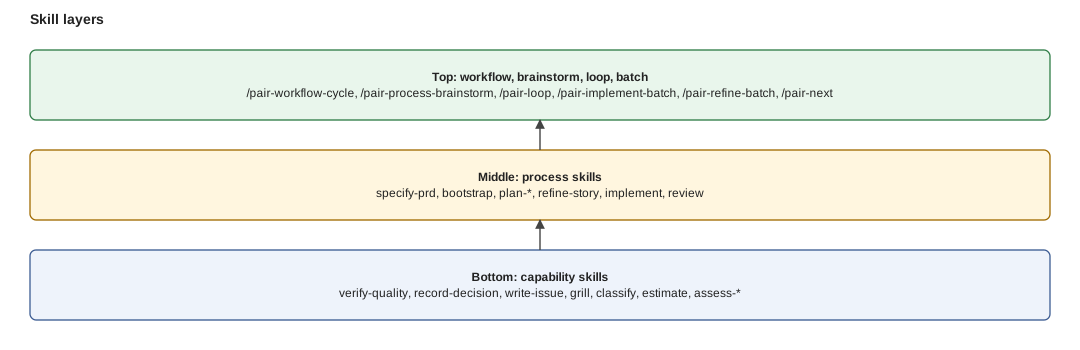
Figure: arrows only point down. Start at the layer whose granularity matches the control you want; everything below it is called for you.
- Capability skills do one reusable operation: verify quality, record a decision, write an issue, grill, classify. See capability skills.
- Process skills run one lifecycle step and compose capabilities. See process skills.
- Workflow, brainstorm, loop and batch skills orchestrate many steps. See workflow skills and loop and batch entry points.
What each upper-layer skill drives
| Skill | Drives |
|---|---|
/pair-workflow-cycle | the stage skills, which run /pair-process-implement, /pair-process-review, /pair-capability-verify-quality, /pair-capability-publish-pr |
/pair-refine-batch | /pair-process-refine-story, /pair-process-plan-tasks |
/pair-implement-batch | /pair-workflow-cycle stages for many cards |
/pair-process-brainstorm | /pair-capability-grill, /pair-process-plan-epics, /pair-process-plan-stories |
/pair-loop | the batch workflows, which run the cycle |
/pair-next | suggests a process skill; runs none |
You normally start at the top (/pair-next, /pair-workflow-cycle) and let it call down. Drop a layer when you want control: run a process skill by hand, or a capability on its own. Every skill, with its command and what it composes: Skills catalog.
Next: Tag-driven automation, what tags let automation do.