The delivery cycle in depth
The delivery mechanism stage by stage, the cycle and its authority, the three realizations, profiles, Cycle Hooks, the merge stage, host adapters, timeouts and how unattended work flows end to end.
You do not need all of this at once
This page is dense on purpose: every stage, realization and setting of the cycle is here so that, when you need to, you can configure one piece selectively and leave the rest alone.
If you want guidance through the options, /pair-assistant (optional, Claude Code) walks you through them and writes the configuration for you. Otherwise the default configuration is fine: the high-level skills (/pair-workflow-cycle, /pair-loop, or pair-cli run) automate delivery without you touching any of it.
The in-depth companion of the delivery workflow: what the cycle is, how each stage works, which realization runs it, how it is configured, and how unattended work flows through it.
This page is a map, not a second copy of the territory. Exact argument names, refusal identifiers, schema fields and script paths live in the owning skill, script or guideline and are linked from here, so a change there cannot leave this page stale on that fact. Where this page and an owner disagree, the owner wins and this page is the bug.
Contents
- The cycle and its authority
- The stages, one by one
- Three realizations, and which to use
- Profiles: engine, model, effort, context per stage
- Cycle Hooks
- The
mergestage and the merge gate - Host adapters: PM tool and code host
- Automation as one whole
- Timeouts, stalls and retries by surface
- Where to go next
1. The cycle and its authority
A delivery cycle drives ONE card to a review-approved pull request, and optionally to a merge. It is a state machine with two entries and two stage sequences:
| Entry | Sequence | Notes |
|---|---|---|
| Fresh card: refined, no PR yet | implement → verify → merge | Tests and code are written together, test-first, inside implement; the independent verify judges the result qualitatively, per acceptance criterion. There is no up-front contract. |
| Review finding: a PR with blocking findings | prepare → validate → green → verify | One remediation round per group of findings: its failing test first, written by someone who is not the fixer, sealed by an independent validator, then fixed. |
| Existing PR: fix & review | enters at verify, then the finding sequence | The card's preparation state is not consulted: a card with a PR has started. |
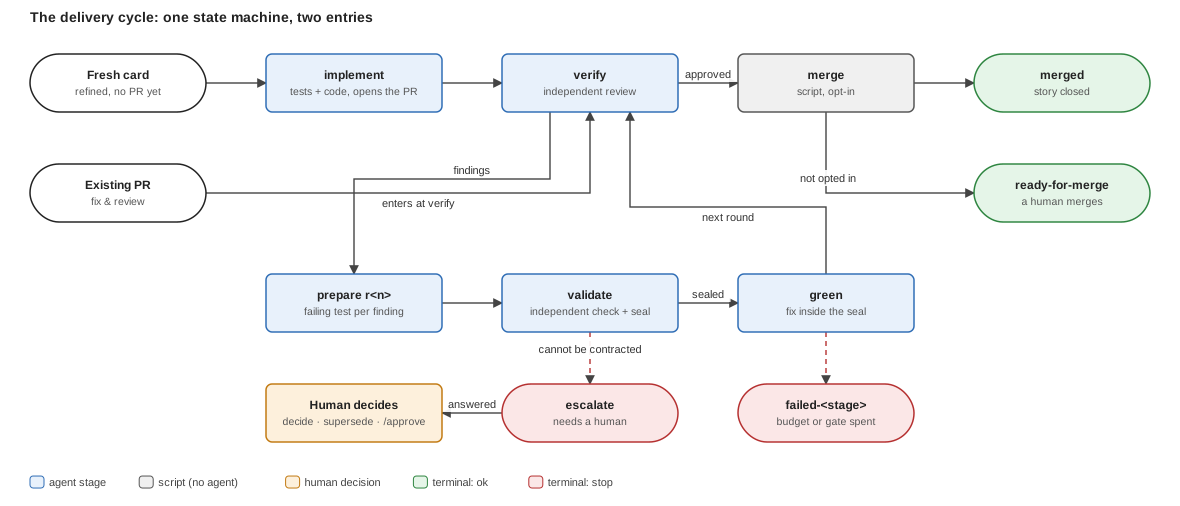
Figure: two ways in (a fresh card at the top, a PR with findings on the left), one loop, and every exit is a human decision point.
One rule authority. cycle-state.mjs alone decides what is due: stage order, retry budgets, round caps, resume after an interruption, and per-stage context freshness. Every realization asks it "what is next?", dispatches exactly that stage, forgets everything but the answer, and asks again. No coordinator, skill or driver holds a cycle rule of its own, which is why the three realizations in section 3 behave identically.
State is files, not memory. Each stage publishes a handoff under the run directory; the next question is answered from those files. A cycle interrupted at any point resumes from its first incomplete stage.
Independence is structural. The agent that implements never reviews; the agent that writes a finding's failing test is never its fixer; the validator never repairs. Only independent review activities are recorded as evidence.
Operational detail: the pair-workflow-cycle skill (in-session coordinator, #486), the cycle-state.mjs script, and the merge stage (#490) in section 6. The design is recorded in ADR-024.
2. The stages, one by one
Every stage is a skill run by one role. cycle-state.mjs also decides whether the stage gets a fresh agent (the default) or resumes the previous agent of the same role (reuse); resuming is admitted only inside one role, never into validate or verify, whose whole value is independence.
| Stage | Role | Skill |
|---|---|---|
implement | implementer | pair-workflow-implement-phase |
verify | reviewer | pair-workflow-review-phase |
prepare | test author | pair-workflow-red-spec |
validate | contract validator | pair-workflow-red-verify |
green | implementer (fixer) | pair-workflow-green-fix |
merge | none: a script | cycle-merge.mjs |
Each subsection below says what the stage is for, who runs it, what it reads and produces, when it is skipped, and how it ends. The what and why is here; the argument lists are in the skills.
implement
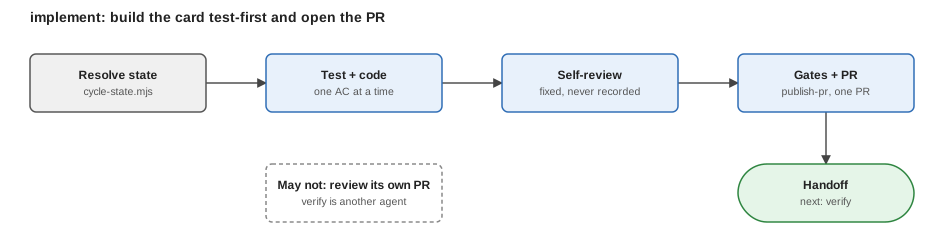
Figure: implement asks the state script first and publishes last; everything between is test and code, one acceptance criterion at a time.
- For: turning a refined card into verified commits and exactly one PR, written test-first, for each acceptance criterion a test that would fail without the behavior, then the code.
- Who / context: the implementer,
fresh. - Reads → produces: the card and the base branch → commits in the story worktree, a checkpoint, the PR (created or updated, never duplicated), and the stage handoff.
- Self-review: the implementer reviews its own diff against the acceptance criteria and fixes what it finds, and records nothing of it, so the verifier judges the result without the author's conclusions in front of it.
- Skipped when: a PR already exists for the card (the cycle enters at
verify). - Ends: success: handoff published, next is
verify; a red gate still publishes the PR and routes one retry on the same base; a second red gate stops the cycle.
verify
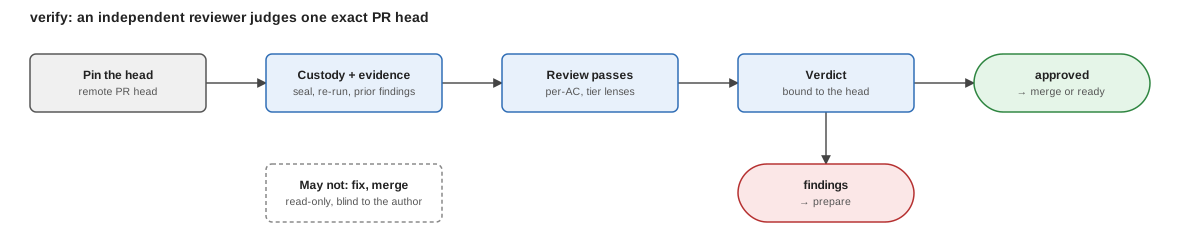
Figure: verify pins the PR head before reading anything, so the verdict is about exactly one commit.
- For: an independent judgment of one exact PR head: that the sealed evidence is intact, that every acceptance criterion has a test proving it, that prior findings are resolved, and that the adopted risk-tier passes find nothing blocking.
- Who / context: the reviewer, always
fresh, read-only on code. It sees the card, the PR and the code, never the implementer's checkpoint. - Reads → produces: PR head, card, handoffs → one review with stable finding ids, a verdict and the head it reviewed, published idempotently.
- Skipped when: never. Every path to a merge or a ready PR passes through it, and a moved head needs a new one.
- Ends: approved, the cycle advances to
merge(or stops ready-for-merge); blocking findings at or above the project's floor, a remediation round starts atprepare; a finding only a human can settle,escalate.
prepare
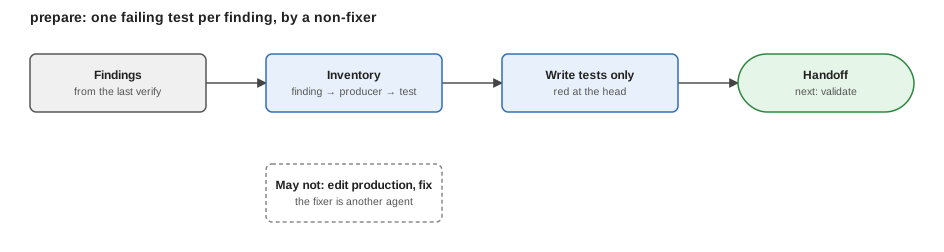
Figure: prepare turns findings into failing tests before any production edit, and the author is never the one who will fix them.
- For: turning each blocking finding into an executable acceptance contract (a failing test that proves the finding at the unfixed head, plus controls that must keep passing) before anyone touches production code.
- Who / context: the test author,
freshon the first round and eligible toreuseitself across rounds. It writes tests and fixtures only, and is never the fixer. - Reads → produces: the findings of the last
verify→ test files and the contract handed tovalidate. - Skipped when: a fresh card with no findings; the cycle never starts here without a review having found something.
- Ends: a contract ready for
validate; or a typed refusal (the finding cannot be proven, must be split, is stale) that stops or escalates the group.
validate
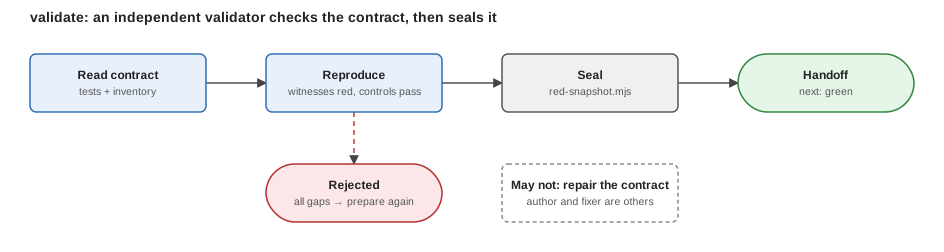
Figure: validate reproduces every witness against the unfixed base; one typed rejection lists every gap, or the seal lands.
- For: an independent check that the contract really discriminates (each witness fails at the unfixed head for the intended defect, each control may pass) and a deterministic seal: the tests become an immutable snapshot commit the fixer cannot alter.
- Who / context: the contract validator, always
fresh. It never repairs a contract. - Reads → produces: the contract and the base → either one typed rejection listing every gap found, or a sealed snapshot.
- Skipped when: never inside a round: it is the gate between
prepareandgreen. - Ends: sealed (next is
green; rejected) back topreparefor a bounded number of repairs, then the cycle stops.
green
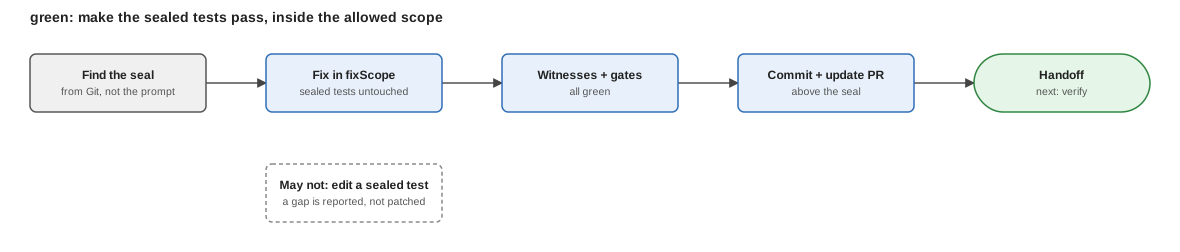
Figure: green starts from the seal, may touch only the allowed scope, and ends with the same witnesses now passing.
- For: making the sealed tests pass by changing production code only inside the contract's allowed scope, then updating the existing PR.
- Who / context: the implementer as fixer,
freshor resumed within its own role. A sealed test is untouchable: a gap in the contract is reported, never patched around. - Reads → produces: the seal (discovered from Git, never trusted from a prompt) → commits above the seal, the updated PR, an evidence ledger.
- Skipped when: never inside a round.
- Ends: success (next is
verify; an approved test that still fails) one retry on the SAME seal; a fixer that needs a human decision posts its escalation itself.
merge
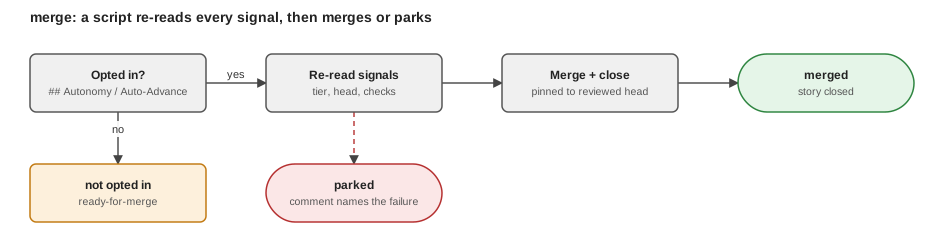
Figure: merge re-reads every signal from the host before acting; any signal that is not success parks the card instead.
- For: executing the merge of a review-approved PR, only when the project opted in. Detail in section 6.
- Who / context: nobody: it is a script, not an agent dispatch.
- Reads → produces: freshly re-read signals → a merge and a closed story, or a park with a comment on the card naming the failing signal.
- Skipped when: the project did not opt in (the default): the cycle stops
ready-for-mergeand a human merges. - Ends: merged, merged with closure unfinished, or parked.
Where a human decides
The cycle never decides these for itself: decide records a maintainer's answer to a finding that needs one (the cycle leaves escalate without re-running anything); supersede sets aside an unvalidated attempt so the stage can be redone; the explicit approval of a high-risk PR (/approve) is a recorded human act the merge stage requires. The recovery paths, including a stale card lock and custody after a base merge, are in the pair-workflow-cycle skill.
3. Three realizations, and which to use
One cycle, three ways to turn its crank. They differ in who dispatches the stages, never in what the rules are.
| Realization | Entry point | Dispatches stages with | Story |
|---|---|---|---|
| In-session coordinator | the pair-workflow-cycle skill in Claude Code, Codex, or pi with pi-subagents | the session's own subagent primitive | #486 |
| Console driver | pair-cli run | one fresh engine process per stage, pi, opencode, claude, codex, whatever is on PATH | #487 |
| Claude parallel batch | the pair-implement-batch workflow, driven by pair-loop (batch engine) | the Claude Workflow tool, N cards at once | #479 |
Choosing: three questions, in order:
- Are you in a harness with a subagent primitive, working one card with a human nearby? Use the in-session coordinator. It binds the primitive by probing the toolset, not by product name, and refuses cleanly when none is present: the console driver is then the fallback.
- Is there no interactive session (a shell, cron, CI, a daemon) or do you want an engine the session cannot be? Use the console driver. It works on any engine and has no dependency on a vendor's orchestration tool.
--parallel Nis its fan-out (#491): onepair-cli run --cardprocess per allowed card, bounded by dependencies, the mutex analysis and## Max Parallelism, with one card failing never aborting the others. - Are you on Claude Code and want a whole epic's cards in parallel with the orchestration inside the session? Use the Claude parallel batch. Elsewhere the same work is the console driver's fan-out.
The in-session coordinator and the console driver run the cycle's hooks and profiles; the Claude batch runs no cycle hook (section 5). The console driver and the loop also re-select cards over time, which a one-card in-session run does not.
Links out for the mechanics: the pair-cli run reference, the pair-loop skill, and the Max Parallelism section for the ceiling.
4. Profiles: engine, model, effort, context per stage
A workflow profile declares which engine, model, effort and context policy each stage uses (a cheap model with a resumed session for prepare and green, a frontier model with a fresh session for validate and verify) without touching any skill or script. The schema, the cascade, the model classes and the refusals are owned by workflow-profiles.md (#488); both coordinators resolve it through one resolver.
Shape (abridged: the full field table is in the owner):
Cascade: resolved once per run, highest first:
- an external workflow-config file, used verbatim;
- a named profile passed for this invocation;
- the project's declared default profile in
pair.config.json; - the KB default: the engine's own model, default effort,
freshon every stage.
Within a profile, a stage entry overrides only the fields it declares, then defaults, then the KB default. With nothing configured, the cycle runs exactly as it did before profiles existed.
Worked mixed-model example. The profile above runs the work that needs breadth at low cost and the work that needs independence at high capability:
| Stage | Model | Context | Why |
|---|---|---|---|
implement | by-tier (from the card's risk:*) | fresh | cost follows risk |
prepare | cheap | reuse | writing tests from findings is mechanical; resuming keeps what the author learned |
validate | frontier | fresh | the independent check is the cycle's quality gate |
green | cheap | reuse | the fix is bounded by the sealed tests |
verify | frontier, high effort | fresh | the final judgment is what a human relies on |
Because prepare and validate apply to remediation rounds only, a profile must not assume every stage runs on every card: a fresh card runs implement and verify first.
context is validated, not trusted. A stage entry asking reuse into a stage where the cycle's transition table forbids it (validate and verify above all) is rejected at load, never accepted and silently overridden at dispatch. The table is cycle-state.mjs's (the rule is in workflow-profiles.md).
Audit, not input. The resolved profile's name and content hash are recorded in every handoff but excluded from the inputs that invalidate evidence: swapping a profile between invocations re-validates nothing.
5. Cycle Hooks
## Cycle Hooks in tech/automation.md declares deterministic commands around the cycle, fail fast on a bad toolchain, realign generated mirrors before a stage, notify on an outcome, alert on a stop (#489). The schema, the per-command timeout, hook-name rules and the fail-safe default are owned by automation-policy.md.
The hooks are executed by the coordinator (the in-session skill or the console driver) never by the stage's own agent, through one shared executor, so the two cannot drift. The Claude parallel batch has no shell and runs none.
Blocking vs logging: the distinction that matters:
| Kind | Hook names | A non-zero exit |
|---|---|---|
| Blocking | pre-<stage>, pre-cycle | stops the cycle before the stage runs; the command's own output is reported verbatim |
| Logging | post-<stage>, post-cycle, on-halt | is logged, never a stop: the stage already happened, remaining commands still run |
Every hook point and its typical use:
| Hook point | Typical use |
|---|---|
pre-cycle | check the toolchain, fail fast on a dirty environment (runs in the main checkout, never in a story tree) |
pre-prepare, pre-validate | fetch/refresh fixtures the contract stages read |
pre-implement | install dependencies, realign the generated mirrors, start a local service the tests need: all in the story worktree |
pre-green | same as pre-implement, for a remediation round |
pre-verify | an external gate the verifier must find green (a build), blocks verify on failure |
pre-merge | a last local check before an automatic merge, blocks the merge on failure |
post-<stage-id> | notifications, metrics, audit lines, anything whose failure must not stop the cycle |
post-cycle | notify the outcome, clean up what pre-cycle created |
on-halt | alert a human: the deterministic notification point for every failure path |
Stage hooks run in the story worktree, the tree the stage works on; cycle-level hooks run in the main checkout. A hook name is a pattern over the stage ids cycle-state.mjs enumerates, so a stage added later gets its hooks with no schema change; a typo is a warning at load, not a stop.
6. The merge stage and the merge gate
The merge stage (#490) is the cycle's last, and it is opt-in per project. A review-approved PR stops ready-for-merge and a human merges it: that is the default, and it is the fail-closed posture.
The default is no automatic merge. The merge gate of ## Autonomy is always unless written otherwise, and always parks every review-approved card for a human. A maintainer opts in with until: merged plus merge: never (every selected card may merge) or merge: when; has: …; lacks: … (a card matching the condition escalates instead). The legacy ## Auto-Advance section is translated to the same gate by autonomy-policy.mjs ((none) is always, a tier is when; lacks: <tier>) and keeps working (Autonomy).
What the stage re-verifies, on freshly read signals, before any merge: the conjunction that is the merge-allowed synthesis (pr-states.md):
- the card's risk tier, re-read (a mid-run raise parks the card);
- the PR's current remote head is identical to the head that was reviewed (a moved head is never merged);
- the
pair-reviewcheck issuccesson that head; - the
pair-explicit-approvalcheck issuccesson that head (below the highest-risk tier it passes by itself; at that tier it requires a recorded human approval); - every OTHER CI check on that head (check runs and commit statuses, read through the code-host adapter) is
success: a failed one refuses the merge (ci-not-green, halted), a still-running one parks it awaiting the build; - the tier's gate set is green.
Anything unreadable, moved or not success parks the card with the failing item named: it is never merged. On success the merge follows merge-and-cascade: the adopted strategy, story close, parent cascade with read-back, branch deletion.
Relationship to the other declarations. The merge gate answers which cards may merge unattended; it is a switch, never a gate list, and it does not restate what "green" means: that is the quality model's per-tier table. The merge stage enacts it. Every realization reaches the stage through the same script, so the rule has one owner and pair-loop itself holds no merge call. Detail: the Autonomy sections.
7. Host adapters: PM tool and code host
The cycle scripts never call a host CLI themselves: they call the adapter the project's way-of-working.md binds, so every host-specific spelling (binary, arguments, URL shape, label and check vocabulary) lives in one file (#492, ADR-026). The PM tool (cards) and the code host (pull requests) are resolved independently.
The interface is eight methods:
| Method | Side | For |
|---|---|---|
readCard | PM tool | read a card's text and fields |
cardHash | PM tool | derived from readCard by the kit, never written by an adapter |
prHead | code host | the PR head as a 40-hex sha |
upsertComment | code host | create or update a marker-keyed comment, idempotently |
concludeCheck | code host | publish a check conclusion on a given sha |
setPrState | code host | leave exactly one PR-state label |
merge | code host | merge pinned to the reviewed head |
closeAndCascade | PM tool | close the card and every parent whose children are all done |
A further optional set of primitives serves scope decisions and state lookups; omitting one fails only the feature that needs it, typed, naming the method.
Shipped adapters: GitHub and Azure DevOps. A filesystem host is the extension guide's worked example.
Adding a host is one new file plus one declaration, never an edit to an existing adapter or to cycle-state.mjs. The validated step-by-step guide, including the file layout and the checks an adapter must pass, is the Host Adapter Extension Guide. Credentials are never read, stored or printed by an adapter: the host CLI authenticates itself.
8. Automation as one whole
Unattended work is the cycle plus five things around it: a trigger, a dispatch, gates, safety rails, and a way out.
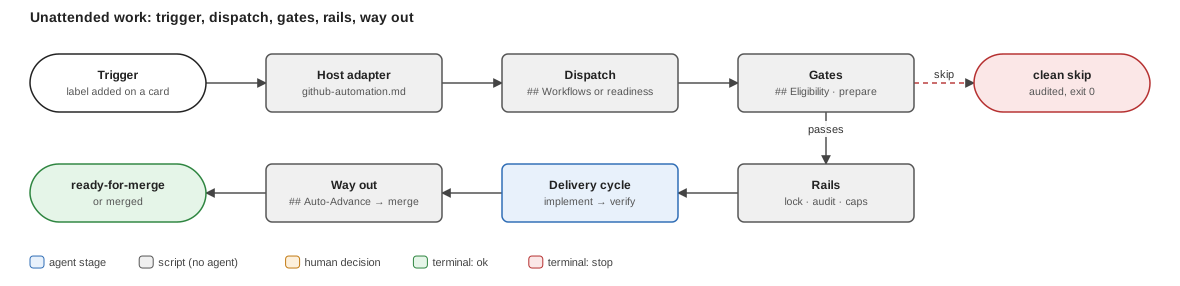
Figure: the cycle sits in the middle; the trigger and the host adapter feed it, the gates and rails bound it, and the way out is always a parked card or a human.
- The trigger. A tracker event (a label added to a card) reaches the host adapter, the thin per-host piece that holds the credentials the trigger runs under. It calls the dispatcher; it carries no cycle rule. See github-automation.md and #492.
- The dispatch. The console driver (or
pair-loop) readstech/automation.mdand maps the card's tags through## Workflows(automation-policy.md). A tag is an opaque routing key; an untagged card is never routed by tag. With no mapping, the card's own Definition of Ready decides: a Ready card with a task breakdown enters the cycle, a card with a PR enters atverify. - The gates. The
## Autonomyfilterbounds--autonomousruns: a card without a listed label is skipped as ineligible, and--approve-ineligiblelets exactly one run through. Unattended runs never start a preparation skill unless thepreparegate says so (alwaysby default: a human prepares). A card that cannot be read is a clean skip. - The safety rails. An exclusive per-card lock (no timeout; SIGTERM and SIGINT release it, so re-running the same command continues the run); an audit trail,
start,skip,end, with the start also printed as aDISPATCH-RECORD:line the adapter can post on the card; the dispatch cap; and## Max Parallelismas the ceiling on fan-out. An escalation condition in## Autonomystops the cycle with one marker-keyed comment on the card. - The way out. The
mergegate of## Autonomyand themergestage (section 6). By default the run ends ready-for-merge and the merge stays a human decision.
A reader can predict any card's outcome by walking these in order: is it mapped or Ready? eligible? unlocked? does a prepare or escalation condition fire? has the project opted into merge for its tier?
Worked example: a label to a PR ready for merge, no one present
Setup: ## Workflows maps auto-dev to the cycle; ## Autonomy declares filter: risk:green and leaves the merge gate at always. Card 123 is Ready, has a task breakdown, and carries risk:green.
| # | What happens | Printed / recorded |
|---|---|---|
| 1 | A maintainer adds auto-dev to card 123. The host adapter fires. | the adapter's own job log |
| 2 | The dispatcher reads automation.md, matches auto-dev, checks eligibility and the card lock. | audit start + the DISPATCH-RECORD: line, posted on the card |
| 3 | implement writes tests and code, opens PR 456. | a handoff; the PR body |
| 4 | verify reviews the exact head. | one review on the PR; the pair-review check |
| 5 | Blocking findings? A remediation round runs prepare → validate → green → verify until clean or the budget is spent. | one handoff per stage |
| 6 | Approved, the merge gate is always ⇒ no merge stage. | audit end; status ready-for-merge |
| 7 | A human merges PR 456. | n/a |
Had the policy declared until: merged and merge: never, step 6 would have run the merge stage: re-read the signals, merge pinned to the reviewed head, close the story and cascade to its parent, or park with a comment naming the signal that failed.
The mechanics of every step are in the owner links of sections 1–7; the walk-through as a hands-on tutorial is on the docs site (Automated development).
9. Timeouts, stalls and retries by surface
What bounds a stage that hangs, and what is retried, differs by who drives the cycle. The rules of the cycle never change; the enforcement does. Single owner of this table, other pages link here.
| Surface | What bounds a hang | What happens next |
|---|---|---|
pair-cli run (console driver, tier 2) | One wall-clock watchdog per engine process: --iteration-timeout <seconds> (default 1800). It covers every cycle stage, every run --skill iteration and the loop's pair-next selection process (same bound, passed to each). No terminal event in the stream within the bound ⇒ the engine gets SIGTERM and the run is reported stalled (a terminal event already read keeps its outcome). | A stalled stage is re-dispatched fresh, sharing the dead-dispatch budget policy.deadDispatchRetries (default 1, read from cycle-state); the next unadvanced handoff ends the cycle failed-<stage>. A stalled or failed selection stops the loop selection failed (exit 1) and is never retried. |
pair-cli run --parallel / --watch (the loop) | The same watchdog per child run --card, plus the per-card lock (no timeout of its own). | Transient failures are retried: a child that crashed, was killed, or never reported a cycle status (engine/API error) is retried within the per-run retry budget (default 1, printed in the loop header and audited). A durable terminal, a reported failed-contract or any failed-*, or escalate (the review/fix budget is spent, a human decision is owed), is reported with its reason and excluded, never retried. An escalated card (an autonomy gate fired) is not durable: it is skipped until its escalation is cleared, then re-picked. A lock whose holder pid is dead on this host (a SIGKILLed driver) is a stale lock: reclaimed and audited lock-reclaimed; a live holder is respected (locked by pid P (alive)). |
In-session /pair-workflow-cycle (any harness) | The coordinator enforces it, not a process: Step 4 of the skill: a stage that is still running but makes no progress for its time bound is a stall. | Resume it once on the same subagent (or re-dispatch the same prompt fresh where resume is unavailable), within the same deadDispatchRetries budget as a dead dispatch; then failed-<step>. A stage may never leave a command in the background or end its turn on one (headless stage execution). |
Claude Code Workflows (pair-loop, pair-implement-batch) | The runtime's agent() has no timeout option, so each call races a timer: args.agentTimeoutMinutes (default 30 minutes, aligned with the 1800 s of pair-cli) when the sandbox exposes setTimeout; where it does not, the call is unbounded and the limit cannot be enforced. | A selection that times out is retried once, then the run ends failed: true, reason: "selection failed: timeout after <n>m"; any other pair-loop stage that times out fails the run naming the stage; a pair-implement-batch stage agent that times out is NOT retried (the runtime cannot cancel it, so it may still be writing to the worktree and a retry would be a second writer: the stage ends failed-<step> with timed out after <n>m) the agent may still be running; human check required, and a human must check the worktree before re-running. The loop retries only transient failures and keeps no cross-run halt memory beyond the card's current durable state. |
/pair-loop in other coding agents | No loop runs there: the skill drives exactly one eligible card per invocation and prints a continue-token; the caller re-invokes it. | Unattended multi-card delivery on those agents is the console driver (first row). |
10. Where to go next
| You want to… | Read |
|---|---|
| run one card in your session | the pair-workflow-cycle skill |
| run from a shell or cron, or fan out | the pair-cli run section of the CLI reference |
| choose models per stage | workflow-profiles.md |
| declare the filter, workflows, gates, hooks, caps | automation-policy.md |
| wire GitHub triggers | github-automation.md |
| add a PM tool or code host | Host Adapter Extension Guide |
Known limitation: a link check catches a broken anchor, not a semantic change in a linked owner. If an owner's behavior changes shape, this page is updated in the same change.
Next: Lifecycle modes, who drives the cycle and on which assistant.