Skills
How Agent Skills work in pair, the open standard for structured AI assistant instructions, skill categories, and composition.
Skills are structured instructions that AI assistants discover and execute. They follow the Agent Skills open standard, supported by Claude Code, Cursor, VS Code Copilot, and OpenAI Codex.
Where the Knowledge Base provides context, skills provide actions. A skill tells the AI exactly how to perform a specific task, from creating a PRD to reviewing a pull request.
How Skills Work
Each skill is a SKILL.md file that defines:
- What the skill does: purpose and scope
- When to use it: trigger conditions
- How to execute it: step-by-step instructions the AI follows
- What it composes: other skills it calls during execution
When a developer invokes a skill (for example /pair-process-implement), the AI reads the SKILL.md file and follows its instructions precisely. The skill references adoption files, guidelines, and templates from the Knowledge Base, ensuring consistent execution.
Skill Categories
pair organizes skills into families: process and capability skills, workflow skills, loop and batch entry points, and one plugin skill.
Process Skills
Process skills guide the AI through lifecycle phases. They follow a defined sequence and often compose capability skills:
| Skill | Purpose |
|---|---|
/brainstorm | Discovery: structured discovery into a Draft backlog tree |
/specify-prd | Create or update a Product Requirements Document |
/bootstrap | Orchestrate full project setup |
/plan-initiatives | Create prioritized strategic initiatives |
/plan-epics | Break initiatives into epics |
/plan-stories | Break epics into user stories |
/refine-story | Add acceptance criteria and technical analysis |
/plan-tasks | Create implementation tasks |
/implement | Implement a story task-by-task |
/review | Perform structured code review |
Capability Skills
Capability skills perform specific, reusable operations. They are invoked independently or composed by process skills:
| Skill | Purpose |
|---|---|
/verify-quality | Run quality gates against the codebase |
/record-decision | Record architectural, non-architectural, or domain decisions, or log a completed technical analysis |
/assess-stack | Evaluate and register new dependencies |
/verify-adoption | Check code against adoption file compliance |
/verify-done | Check Definition of Done criteria |
/write-issue | Create or update issues in the PM tool |
/estimate | Estimate story size |
Workflow Skills
Workflow skills are the stages of the delivery workflow. A stage skill does one stage of one card (one role, one handoff) and is dispatched by the coordinator or the batch engine, never suggested by /pair-next. You normally invoke only the coordinator.
| Skill | Role |
|---|---|
/pair-workflow-cycle | coordinator: drives one card through the stages |
/pair-workflow-contract-phase | stage: fresh acceptance contract |
/pair-workflow-implement-phase | stage: implement and open the PR |
/pair-workflow-red-spec | stage: write the failing test of a finding |
/pair-workflow-red-verify | stage: validate and seal that test |
/pair-workflow-green-fix | stage: fix above the seal |
/pair-workflow-review-phase | stage: independent verification of the PR head |
Detail: Delivery cycle, Skills Catalog. How the layers stack: Skill layers.
Loop and Batch Entry Points
/pair-loop selects eligible cards and repeats under the autonomy gates. It composes the batch workflows pair-implement-batch and pair-refine-batch (installed in .claude/workflows/), which dispatch five subagents installed in .claude/agents/:
| Subagent | Role |
|---|---|
pair-implementer | implements and publishes |
pair-fix-test-author | writes a finding's failing test |
pair-contract-generator | prepares the acceptance contract |
pair-red-contract-verifier | validates and seals it |
pair-reviewer | verifies the PR head |
See Batch engine.
Plugin Skill
/pair-assistant is the single bootstrap skill the optional Claude Code plugin ships. The CLI never installs it into your project; it installs pair and configures it. See Claude Code plugin & /pair-assistant.
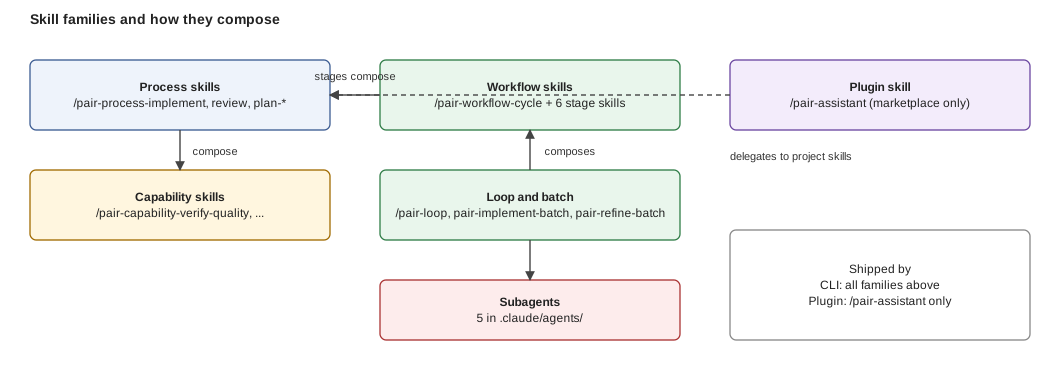
Figure: process skills compose capability skills, never the other way round; the workflow row on top only orchestrates.
Composition
Skills compose other skills to build complex workflows. For example, /implement composes:
/verify-quality: after each task, to check quality gates/record-decision: when a new architectural decision is made/assess-stack: when a new dependency is introduced/verify-adoption: before committing, to check compliance
And /review composes:
/verify-quality: to check quality gates on the PR/verify-done: to check Definition of Done criteria/analyze-debt: to analyze and report technical debt/record-decision: if a decision needs recording
Across families: process skills compose capability skills; /pair-workflow-cycle composes the stage skills (which in turn compose /pair-process-implement, /pair-process-review and the capability skills); /pair-loop composes the batch workflows; /pair-assistant delegates to the project's own skills.
This composition means complex processes are built from simple, tested parts. Each capability skill works the same whether invoked directly or composed by a process skill.
The /next Entry Point
At the start of any session, running /next reads the project's adoption files and PM tool state to recommend the most relevant action. It tells you which skill to invoke based on where your project is in the lifecycle.
Distribution
Skills are stored in .skills/ within the KB and distributed to AI tool directories:
The canonical copy goes to .claude/skills/. Secondary targets receive symlinks, so all AI tools share the same skill definitions. The directory structure uses a flatten/prefix naming convention: process/implement becomes pair-process-implement.
What ships where. pair-cli install and update write the process, capability, workflow and loop skills into .claude/skills/, the batch workflows into .claude/workflows/ and the subagents into .claude/agents/. The marketplace plugin ships only /pair-assistant.
Next: Adoption files, the decisions every skill reads first.